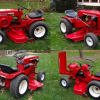
Al C. 1,474 #1 Posted June 12 I asked AI whether someone could have saved Wheel Horse. Here is its assessment: An analysis of the outdoor power equipment industry indicates that saving the Wheel Horse brand without compromising its heavy-duty, cast-iron quality was highly improbable. The brand’s demise was driven by structural shifts in the market rather than simple corporate mismanagement. To understand why the brand could not survive in its original form, one must look at the specific economic and competitive pressures that dismantled the premium garden tractor market. ### 1. The Bifurcation of the Market During the 1970s and 1980s, the market for residential outdoor power equipment split into two distinct segments, leaving the traditional heavy garden tractor without a viable customer base: * **The Rise of Sub-Compact Utility Tractors (SCUTs):** For consumers who actually required ground-engaging capabilities (plowing, tilling, heavy towing), Japanese manufacturers—most notably Kubota—entered the U.S. market. These machines featured diesel engines, true category-0 or category-1 three-point hitches, and robust shaft-driven power take-offs (PTOs). Wheel Horse tried to compete with large-frame machines like the D-Series, but they were fundamentally stretched lawn tractor designs competing against miniaturized agricultural tractors. * **The Commodity Lawn Mower:** For consumers who merely needed to cut grass, the market shifted toward disposable, stamped-steel lawn tractors. Mass retailers and big-box stores demanded low-cost units. Consumers proved unwilling to pay a massive premium for a cast-iron Uni-Drive transmission and a heavy-gauge welded frame just to maintain a standard suburban lawn. ### 2. The Economics of the Independent Dealer Network Wheel Horse’s business model relied entirely on a dedicated, independent dealer network. These dealers provided custom fabrication, mechanical diagnostics, and long-term parts support. * When Toro acquired Wheel Horse in 1986, the industry was shifting toward mass distribution via big-box retailers. * A premium, heavy-duty machine cannot be sold profitably through a department store or home improvement center because these channels demand high margins and low price points. * Without the high-volume sales of lower-tier units to subsidize the dealer network, independent shops could not survive on low-volume, high-cost garden tractor sales alone. ### 3. The Cost of Over-Engineering The defining characteristic of classic Wheel Horse tractors—such as the late 400-series 8-speeds—was their heavy, standardized construction. * **Production Costs:** Manufacturing heavy cast-iron transaxles and thick steel frames in South Bend, Indiana, became cost-prohibitive as commodity raw materials and domestic labor costs rose. * **The Longevity Paradox:** Because Wheel Horse machines were engineered to last for decades with basic maintenance, the replacement cycle for existing customers was exceptionally long. A company cannot survive on replacement parts alone when its primary product line is virtually indestructible and new unit sales stall. ### Summary of Strategic Dead End | Strategic Path | Required Action | Outcome | |---|---|---| | **Maintain Original Quality** | Keep cast-iron components, heavy frames, and independent dealer support. | Price remains too high for suburban homeowners; capability remains inferior to compact diesel tractors. **Result: Bankruptcy due to lack of volume.** | | **Pivot to Sub-Compact Diesel** | Engineer a completely new, shaft-driven diesel platform from scratch. | Requires capital investments well beyond Wheel Horse's financial capacity under AMC or Toro. **Result: Out-competed on price and engineering by Kubota and John Deere.** | | **Adapt to Mass Retail (The Actual Path)** | Use pressed-steel frames, plastic components, and shared platforms. | Brand survives as a badge-engineered label until total elimination in 2007. **Result: Survival achieved only by eliminating original quality.** | Ultimately, Wheel Horse was a victim of a changing society where small-scale hobby farming declined, suburban lawns shrank, and consumer preferences shifted away from repairable capital goods toward disposable convenience. To save the brand without compromising the quality of the machine would have required an entirely different macroeconomic environment. 1 3 6 Share this post Link to post Share on other sites
Pullstart 71,242 #2 Posted June 12 They kind of nailed it. I wonder how much information from a site like RedSquare it took to make that summary? 3 1 1 Share this post Link to post Share on other sites
SylvanLakeWH 32,505 #3 Posted June 12 It's called plagiarism on steroids... 5 Share this post Link to post Share on other sites
Al C. 1,474 #4 Posted June 12 In 1982 the SK-486 cost roughly $1800. Today that would translate to about $7000. That puts it in the range of the John Deere X500 series. The problem, at that price point, John Deere’s margins are MUCH higher than Wheel Horse’s would have been because of Deere’s use of molded plastics and consumables vs steel and cast iron. We’re all lucky to own what’s left of the dinosaurs 🦖. 7 1 1 Share this post Link to post Share on other sites
ri702bill 13,065 #5 Posted June 12 I attribute part of the demise to the fact that WH originally built tractors based on an over-engineered design. In other word, they were too good. Great interchangability of parts over decades, reliable Kohler engines, various grease fittings for high wear areas, and so on. In theory, IF you performed regular maintainance faithfully and stored the tractor inside, you probably would end up with that functionimg worker being dependable for the rest of your life..... Neglect all the above, all bets are off. Why buy another if it suits your needs? 3 1 1 Share this post Link to post Share on other sites
JoeM 10,267 #6 Posted June 12 It's always about money. Cecil Pond sold out to AMC in the 70's? (for money) Hats off to Cecil but he bailed. Investment company's have stock holders and have to produce money...... not so much a product. Toro gets a bad rap but truly it kept the brand alive through the early 2000's. They (Toro) made a good effort to compete with the JD's of the time with the xi machine line and the smaller hydro machines like the 14-38. I figure their network was not concrete enough to go head to head the the MTD style manufactured machines. It is a me not us world now. Americans in particular, have switched their purchasing needs, some so much toward offshore manufactured products that there are very few true USA manufactures left. And the US manufactures now just assemble using offshore parts so they can compete. I have enjoyed these machines over the years. But as far as coming back, not going to happen. I just enjoy the WH machines and those WH people. 5 1 Share this post Link to post Share on other sites
Al C. 1,474 #7 Posted June 12 I agree Cecil sold out for the $$$ in the ‘70’s. I don’t fault him though. He probably saw the writing on the wall, realized that the future trajectory was inevitable, and accordingly captured the full value of the company while it was still available. 4 1 Share this post Link to post Share on other sites
MainelyWheelhorse 3,133 #8 Posted June 12 From what I’ve seen/read the next Pond generation wasn’t interested in taking the “reins” so to speak. I wouldn’t be surprised if that was a factor with Cecil selling out too. 2 1 1 Share this post Link to post Share on other sites
Beap52 2,497 #9 Posted June 12 Great post. Informative. It's not just garden tractors and lawn tractors. Much of the products we now purchase have a short life. (I sometimes wonder if it planned?) Appliance repair man (finally found one) told me this week our refrigerator is not worth repairing . (Cooling fine but interior light is real dim and loud buzzing from an item on a circuit board. Remove light and all is well other than no light inside ref.) When it comes time to replace, he suggested purchase the cheapest refrigerator (that wife could get by with ) and plan to replace every 6 to eight years. He listed a few name brands that he would not purchase and for sure don't purchase a brand whose name you don't recognize or am able to pronounce. I suppose enough of the components of our disposable items are able to be recycled to make this viable. Today, I sold a power miter box that I purchased in 1979. (Still had owner's manual.) Most of my power tools are more than 20 years old. The 520H should out last me. I'm a believer of maintenance. Believe it or not, we even cleaned the cooling fins on our refrigerator. 1 Share this post Link to post Share on other sites
953 nut 69,303 #10 Posted June 12 8 hours ago, MainelyWheelhorse said: From what I’ve seen/read the next Pond generation wasn’t interested in taking the “reins” so to speak. I wouldn’t be surprised if that was a factor with Cecil selling out too. I think Cecil Pond was not too enthusiastic about his offspring having to swim upstream against a rising tide of planned obsolescence lawn equipment. While they would face some hard decisions along the way just as Cecil had it was becoming obvious that bowing out while the company was thriving made the most economic sense. 1 1 1 Share this post Link to post Share on other sites
MainelyWheelhorse 3,133 #11 Posted June 13 3 hours ago, Beap52 said: Great post. Informative. It's not just garden tractors and lawn tractors. Much of the products we now purchase have a short life. (I sometimes wonder if it planned?) Appliance repair man (finally found one) told me this week our refrigerator is not worth repairing . (Cooling fine but interior light is real dim and loud buzzing from an item on a circuit board. Remove light and all is well other than no light inside ref.) When it comes time to replace, he suggested purchase the cheapest refrigerator (that wife could get by with ) and plan to replace every 6 to eight years. He listed a few name brands that he would not purchase and for sure don't purchase a brand whose name you don't recognize or am able to pronounce. I suppose enough of the components of our disposable items are able to be recycled to make this viable. Today, I sold a power miter box that I purchased in 1979. (Still had owner's manual.) Most of my power tools are more than 20 years old. The 520H should out last me. I'm a believer of maintenance. Believe it or not, we even cleaned the cooling fins on our refrigerator. I’ve heard that the large corporations like Kenmore, Whirlpool and others do have something called “planned obsolescence” . A engineered lifespan where products last x amount of years then wear out/break to the extent it’s cheaper to get a new one. People’s phones, lawn tractors, appliances and more are all part of it. 1 1 Share this post Link to post Share on other sites
MainelyWheelhorse 3,133 #12 Posted June 13 3 hours ago, 953 nut said: I think Cecil Pond was not too enthusiastic about his offspring having to swim upstream against a rising tide of planned obsolescence lawn equipment. While they would face some hard decisions along the way just as Cecil had it was becoming obvious that bowing out while the company was thriving made the most economic sense. Many people like my parents got into the mindset and had no need for multi function equipment. if it was cheap and just cut grass it was fine. I like the fact that my stuff can be a Swiss Army knife of lawn equipment. 2 1 1 Share this post Link to post Share on other sites